
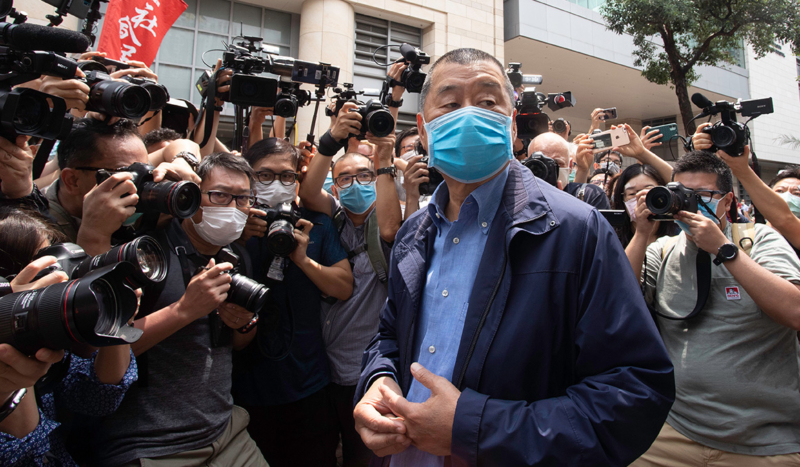
Yung Chi Wai Derek, Shutterstock.com
Now is the opportune moment for President Donald Trump to act to secure pro-democracy activist Jimmy Lai’s release from a Hong Kong prison, where he has been held in solitary confinement for almost five years and is at risk of dying if intervention isn’t immediate, a Washington Post columnist urged in a Sept. 5 op-ed.
For 77-year-old Lai, who is a diabetic, Catholic convert, and British citizen, “time is of the essence,” Kathleen Parker wrote. “In a plea to the United Nations on Wednesday, Lai’s legal team appealed for intervention, offering chilling evidence of Hong Kong authorities’ failure to provide lifesaving treatment to ill prisoners.”
The closing arguments for Lai’s trial took place in August, and Lai could face a life sentence. He appeared in court wearing a heart monitor, as CatholicVote reported. He had experienced heart palpitations concerning enough to cause his trial to be postponed, Parker wrote. According to Parker, Lai has also “suffered drastic weight loss behind bars,” and his profile resembles that of 12 other prisoners who died shortly after being taken to the hospital in the last decade.
There is no telling when a verdict on the case will be given by the court, which does not seem to be in a rush, Parker noted. But the timing of the trial’s conclusion — and the urgency of Lai’s health conditions — presents a good opportunity for Trump to act, preferably in joint action with Britain, the author argued.
China “would lose nothing by releasing [him] now for health reasons,” Parker wrote. She argued that “China’s leaders already have made their point with Lai.” According to sources she’s spoken with, Beijing may now be more inclined to agreeing to his release.
“At this point, releasing Lai would allow Chinese President Xi Jinping to demonstrate that he is open to reason,” Parker later added.
Parker noted that “Trump, for his part, has said on at least three occasions that he would work for Lai’s release,” although the approach he might take is unknown.
“It’s anyone’s guess whether Trump now might offer China reduced tariffs or other incentives to release Lai,” Parker wrote. “But what good is leverage if you can’t save a democratic hero’s life while also relaxing economic tensions?”
The columnist also criticized Britain’s approach to Lai’s situation, writing that the country “has seemed reluctant to pressure China on Lai; its limp efforts to advocate for a citizen incarcerated in Hong Kong have been shameful.”
British Prime Minister Keir Starmer, who took office in 2024, previously said that the government would prioritize securing Lai’s release, but “Starmer’s rhetoric has so far proved fruitless,” Parker wrote.
Trump is set to visit Britain later in September, presenting a chance for Starmer — who could benefit greatly from doing so — to ask the US president for assistance in Lai’s situation, Parker argued.
“This moment presents a chance for the sort of quiet diplomacy China prefers, the grandiosity of a win that Trump covets and a success that Britain sorely needs,” Parker concluded. “Together, the three countries, at zero cost to themselves, could save the life of a great man.”
Parker’s call for government intervention to save Lai’s life comes at the same time that the Committee for Freedom in Hong Kong Foundation (CFHK), a watchdog group, released a harrowing report about the neglect, assault, abuse, and political control in Hong Kong prisons.
The report draws on interviews with former prisoners and others, as well as open-source records, according to the report summary. More than 1,900 people have been imprisoned on political charges since 2019, the summary states.
“Former inmates report widespread difficulties obtaining proper medical care, including untreated seizures, broken bones, and full-body rashes,” Francis Hui and Samuel Bickett, the report authors, wrote in a press release. “We document the case of a prisoner who died due to official neglect after showing severe signs of psychological distress. [Correctional Services Department] staff often dismiss injuries as feigned, refusing requests for treatment. Extraordinary hurdles to receiving specialized care deter most prisoners from even attempting to obtain it, and inmates are often denied their ongoing prescription medication upon entering prison.”
The authors also reported that prisoners suffer from unhygienic conditions and sweltering temperatures.
“Many prison cells leak during rain, toilets stay broken for weeks, insects infest bedding, rats crawl out of toilets, and prisoners are denied air conditioning despite temperatures regularly topping 95 degrees Fahrenheit (35 degrees Celsius) confined with heat-absorbing concrete amid sweltering humidity,” they wrote in the release.
They also reported that political prisoners, including Lai, are regularly subjected to solitary confinement “as a routine form of punishment and control.”
“The testimonies and data in this report make clear,” the authors urged, “that incremental appeals to the authorities will not stop the abuse: only coordinated external pressure, rigorous documentation, and sustained support for prisoners and their families can create real leverage for change.”
